
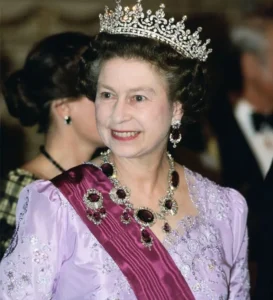
 The British Royal Family is world-renowned for its glittering vault of diamonds, rubies, and sapphires. However, tucked away in the shadows of the more famous crowns lies a set of violet-hued treasures with a history as deep as their colour: The Kent Amethyst Parure.
As the oldest set of jewels in the Windsor family vaults, this parure (or demi-parure, to be precise) offers a fascinating glimpse into 19th-century royal fashion and the sentimental history of Queen Victoria’s lineage.
Introduction
There’s a lot to learn about the Kent Amethyst Parure. From its origins in the mourning courts of the 1820s to its rare appearances on Queen Elizabeth II, this set is a masterpiece of Victorian craftsmanship.
In this guide, we’ll provide you with an overview of the Kent Amethysts’ history, break down the individual pieces that make up the set, and explore why this particular collection is considered an “Heirloom of the Crown.”
Let’s dive in.
Table of Contents
- The Royal Origin Story
- Anatomy of the Parure: The Pieces
- FAQs: Why is it so rare?
- Conclusion: A Legacy in Purple
The Royal Origin Story
The story of the Kent Amethysts begins with Princess Viktoria of Saxe-Coburg-Saal Feld, better known as the Duchess of Kent and the mother of Queen Victoria.
Acquired in the early 19th century, the set was reportedly purchased during a period of significant mourning within the royal family. In the 1820s, purple was the designated color for “half-mourning,” making amethysts the perfect stone for a royal widow who still wished to maintain her status.
From Mother to Daughter
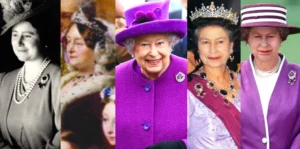
Upon the Duchess’s death in 1861, the amethysts were left to Queen Victoria. Recognizing their historical value, Victoria designated them as Heirlooms of the Crown in her will. This status ensures the jewels are passed from monarch to monarch, never to be sold or broken up, remaining a permanent part of the sovereign’s collection.
Anatomy of the Parure: The Pieces
Technically, the set is a demi-parure because it lacks a matching tiara. However, what it lacks in headwear, it makes up for in sheer volume and intricate design.
1. The Show-Stopping Necklace
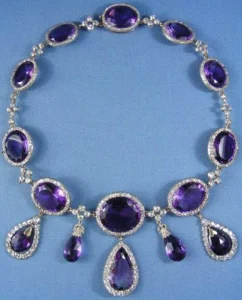
The centrepiece of the collection is a massive necklace featuring eight large, cabochon-cut amethysts. Each stone is surrounded by a halo of diamonds and connected by delicate diamond star motifs. Most notably, the necklace features three detachable amethyst and diamond drops that hang from the front, creating a dramatic silhouette.
2. The Famous Hexagonal Brooch
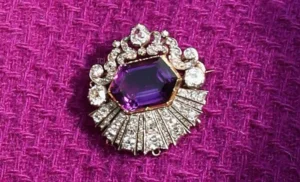
The most frequently seen piece of the set is the Kent Amethyst Brooch. It features a unique hexagonal amethyst framed by diamond scrollwork and sunray patterns. Like the necklace, it has three removable pendants. Queen Elizabeth II was particularly fond of this piece, though she often wore it “plain”—without the dangling pendants—for daytime engagements.
3. The Earrings and Hair Combs
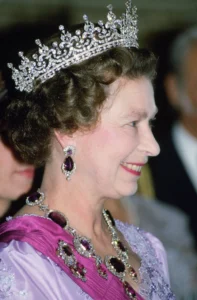
To round out the set, the parure includes:
- Drop Earrings: Two large pear-shaped amethysts suspended from diamond clusters.
- Hair Combs: Two ornate combs designed to be tucked into a formal up do. Interestingly, the combs have not been seen in public for decades, leading to rumours that they may have been repurposed or remain tucked deep in the vault.
FAQs
Is the Kent Amethyst Parure worth learning about?
Absolutely. It represents one of the few surviving pre-Victorian jewellery sets still in active use. Its survival through the 20th century, where many other royal sets were broken down for their stones, makes it a rare survivor of 19th-century aesthetics.
How often do the Royals wear it?
Rarely. While Queen Elizabeth II wore the brooch frequently, she only wore the full set once or twice most notably during a State Visit to Portugal in 1985. Because amethysts are often seen as less “formal” than diamonds or emeralds, the set is usually reserved for specific colour-coordinated events.
Conclusion
The Kent Amethyst Parure is more than just a collection of purple stones; it is a tangible link to the Duchess of Kent and the very beginning of the Victorian era. While we wait to see if Queen Camilla or the Princess of Wales will bring these violet treasures back into the spotlight, their legacy remains secure as Heirlooms of the Crown.
- Final Takeaway: The Kent Amethysts prove that royal style isn’t just about the biggest diamonds it’s about the history and sentiment behind the sparkle.