
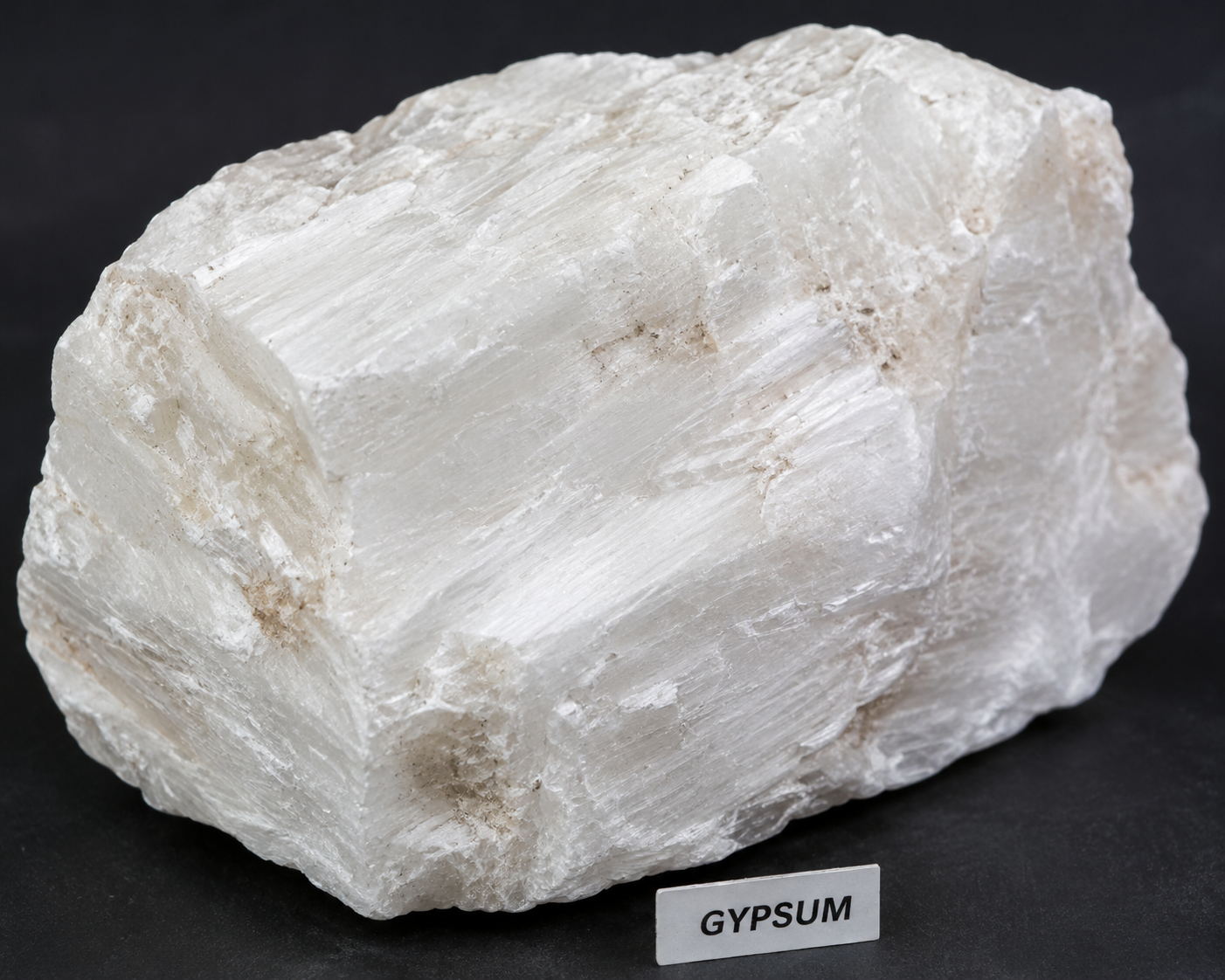
Gypsum stone is a naturally occurring mineral known for its soft texture, beautiful crystal forms, and wide range of industrial and decorative uses. Although it may not be as famous as diamonds, sapphires, or other gemstones, gypsum is an important mineral with unique physical and chemical properties.
From construction materials to decorative objects and mineral collections, gypsum has played an important role in human civilization for centuries. Its distinctive appearance and ability to form transparent and translucent crystals make it particularly interesting to mineral enthusiasts and students of geology.
What Is Gypsum Stone?
Gypsum is a soft sulfate mineral composed primarily of calcium sulfate dihydrate. Its chemical formula is CaSO₄·2H₂O, meaning that water molecules are part of its crystal structure.
Natural gypsum can occur in several forms, including massive, granular, fibrous, and crystalline varieties. Depending on the geological conditions in which it forms, gypsum may appear white, colourless, grey, beige, or slightly pink.
One of the most notable characteristics of gypsum is its softness. It ranks 2 on the Mohs hardness scale, which means it can easily be scratched by a fingernail.
How Does Gypsum Stone Form?
Gypsum commonly forms through the evaporation of mineral-rich water. It is therefore frequently associated with evaporite deposits, where seawater or saline groundwater gradually evaporates and leaves behind dissolved minerals.
Gypsum deposits can develop in:
- Sedimentary environments
- Ancient seas and lakes
- Salt flats
- Evaporite basins
- Underground mineral deposits
Over geological periods, these deposits can produce large quantities of gypsum crystals and massive gypsum rock.
What Does Gypsum Stone Look Like?
The appearance of gypsum varies considerably depending on its crystal structure and impurities.
Pure gypsum is generally colorless or white, but natural specimens can contain traces of other minerals that give them gray, yellow, brown, or pinkish tones.
Some gypsum crystals can be transparent and highly attractive, while other specimens have a more opaque, stone-like appearance.
Its common visual characteristics include:
- White to colorless appearance
- Translucent or transparent crystals
- Pearly or glass-like luster
- Fibrous textures
- Layered or sheet-like crystals
- Soft and easily scratched surfaces
Types of Gypsum
Gypsum occurs in several visually distinct varieties. Some of the best-known forms include selenite, satin spar, and alabaster.
1. Selenite
Selenite is a transparent or translucent crystalline variety of gypsum. Large, clear crystals can display a beautiful glassy appearance.
The name “selenite” is derived from the Greek word associated with the Moon, reflecting the mineral’s characteristic luminous appearance.
2. Satin Spar
Satin spar is a fibrous form of gypsum. It often displays a silky appearance caused by the arrangement of its fine fibers.
This variety is commonly cut and polished for decorative purposes.
3. Alabaster
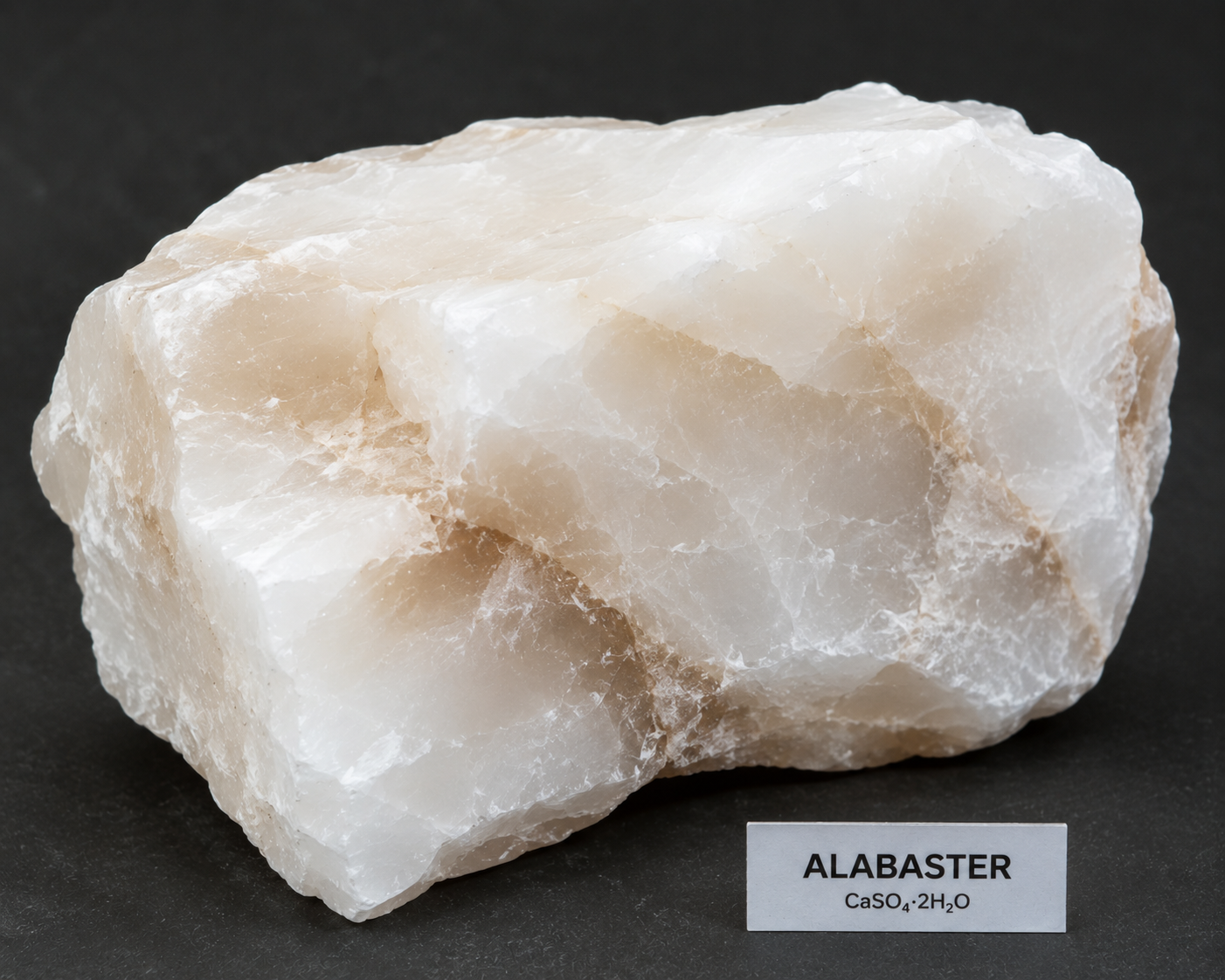
Alabaster is a fine-grained, massive variety of gypsum that is commonly used for carving. It has historically been valued for sculptures, ornaments, decorative objects, and architectural elements
Physical Properties of Gypsum Stone
Understanding the physical properties of gypsum is important for identifying the mineral.
| Property | Gypsum |
|---|---|
| Mineral Group | Sulfate |
| Chemical Formula | CaSO₄·2H₂O |
| Mohs Hardness | 2 |
| Color | Colorless, white, gray, beige and others |
| Luster | Vitreous to pearly |
| Transparency | Transparent to opaque |
| Cleavage | Excellent |
| Crystal System | Monoclinic |
Its low hardness is one of the easiest characteristics to recognize. A gypsum specimen can be scratched relatively easily with a fingernail.
Gypsum Stone vs Other Minerals
Gypsum can sometimes be confused with other light-colored minerals, particularly when it occurs as a transparent or translucent crystal.
However, its very low hardness, excellent cleavage, crystal form, and chemical composition help distinguish it from harder minerals.
For example, quartz has a Mohs hardness of 7, while gypsum has a hardness of only 2. This major difference makes hardness testing useful when identifying mineral specimens.
Uses of Gypsum Stone
Gypsum is one of the most commercially important sulfate minerals. Its applications extend far beyond decorative mineral specimens.
Construction Industry
One of the most important uses of gypsum is in construction. Gypsum is processed to produce materials such as plaster and gypsum board, which are widely used in buildings.
Cement Production
Gypsum is also used in the manufacture of cement. It helps regulate the setting time of cement, making it an important component of the production process.
Decorative Objects
Beautiful varieties of gypsum, especially alabaster and satin spar, can be used for decorative pieces, carvings, ornaments, and mineral collections.
Agriculture
Gypsum can be used as a source of calcium and sulfur in agriculture. It may also be used as a soil amendment in certain agricultural applications.
Art and Sculpture
Alabaster gypsum has been used for centuries in artistic and architectural work because it is relatively soft and easy to carve.
Is Gypsum a Gemstone?
Gypsum is generally classified as a mineral rather than a traditional gemstone. However, certain attractive varieties can be collected, polished, displayed, or used for ornamental purposes.
Clear selenite crystals, for example, can be visually impressive and are popular among mineral collectors.
Its low hardness makes gypsum unsuitable for most everyday jewelry applications because the surface can scratch or damage easily.
Why Is Gypsum Considered a Soft Mineral?
The softness of gypsum is directly reflected in its Mohs hardness of 2. This makes it one of the softer minerals commonly encountered in geology.
Its softness is useful for identification but also limits its durability. Unlike hard gemstones such as sapphire or diamond, gypsum requires careful handling to prevent scratching, breaking, or surface damage.
How to Identify Gypsum Stone
Several simple characteristics can help with the preliminary identification of gypsum:
- Check the hardness: Gypsum can be scratched with a fingernail.
- Observe the luster: Crystals may show a glassy or pearly appearance.
- Examine the cleavage: Gypsum has excellent cleavage.
- Look at the crystal form: Some specimens form distinctive elongated or sheet-like crystals.
- Observe transparency: Certain varieties can be transparent or translucent.
For professional mineral identification, laboratory testing and expert examination may be required.
Interesting Facts About Gypsum Stone
- Gypsum is a hydrated calcium sulfate mineral.
- It has a Mohs hardness of only 2.
- Selenite is a crystalline variety of gypsum.
- Satin spar is known for its silky, fibrous appearance.
- Alabaster is a fine-grained variety used for carving.
- Gypsum deposits are commonly associated with evaporite environments.
- Gypsum is widely used in the construction industry.
- It is also important in cement manufacturing and agriculture.
- Some gypsum crystals can grow to remarkable sizes under suitable geological conditions.
Final Thoughts
Gypsum stone is a fascinating mineral that combines geological importance with practical applications. Its soft nature, distinctive crystal forms, and attractive varieties such as selenite, satin spar, and alabaster make it an interesting subject for mineral collectors, geology students, and anyone interested in natural stones.
While gypsum is not typically considered a durable gemstone, its unique properties and extensive industrial applications make it an important mineral to understand. Learning about its formation, physical properties, varieties, and uses provides valuable insight into the diverse world of minerals and natural stones.