
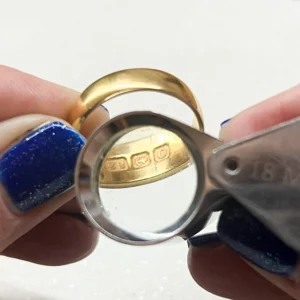
Gold jewellery is an important purchase for many Indian families, whether it is bought for weddings, festivals, gifts, or everyday wear. However, before purchasing gold, it is essential to understand its purity and know how to verify the markings on the jewellery.
How to check gold purity is a common question among buyers who want to ensure that the gold they purchase matches the purity promised by the seller. In India, BIS hallmarking, the Hallmark Unique Identification (HUID) number, and karat markings help consumers make more informed decisions.
This guide explains gold purity, hallmark symbols, HUID verification, karat values, and the steps you can take before buying gold jewellery.
What Is Gold Purity?
Gold purity refers to the proportion of pure gold present in a piece of jewellery or another gold item. Pure gold is naturally soft, so it is commonly mixed with other metals to improve its suitability for jewellery manufacturing.
The amount of gold in an alloy affects its purity. For example, 22K gold contains a higher proportion of gold than 18K gold.
Gold purity is commonly expressed in two ways:
- Karat (K): Indicates the proportion of gold out of 24 parts.
- Fineness: Indicates the number of parts of pure gold per 1,000 parts of the alloy.
Understanding these measurements helps buyers compare different types of gold jewellery.
What Is Gold Hallmarking?
Gold hallmarking is a process through which the purity or fineness of a precious metal article is assessed and officially marked under an applicable hallmarking system.
In India, the Bureau of Indian Standards (BIS) operates the hallmarking scheme for gold and silver jewellery. A BIS hallmark provides third-party assurance about the declared purity of a hallmarked article.
When purchasing gold jewellery, buyers should look for the applicable BIS hallmark and verify its details rather than relying only on a seller’s verbal assurance.
How to Identify a BIS Hallmark on Gold Jewellery
Hallmarked gold jewellery covered by India’s current HUID system carries three main components:
- BIS Standard Mark: Identifies the BIS hallmark.
- Purity or fineness mark: Indicates the declared gold purity, such as 22K916 or 18K750.
- Six-character alphanumeric HUID: A unique identification number assigned to the hallmarked article.
These markings may be small, so ask the jeweller to show them clearly, using a suitable magnifying glass if necessary.
The BIS hallmark and HUID can be checked through the official BIS Care app.
What Is HUID in Gold Jewellery?
HUID stands for Hallmark Unique Identification. It is a six-character alphanumeric code assigned to an individual hallmarked jewellery article.
The HUID system helps make hallmarked gold jewellery traceable. Consumers can use the official BIS Care app’s “Verify HUID” feature to check the details associated with the code.
How to Check HUID Online
Follow these steps before purchasing hallmarked gold jewellery:
- Locate the six-character HUID marked on the jewellery.
- Download or open the official BIS Care app.
- Select the “Verify HUID” feature.
- Enter the HUID exactly as it appears on the jewellery.
- Review the details displayed in the app.
- Compare the displayed article type and purity with the jewellery you intend to purchase.
If the details do not match, ask the jeweller for clarification before completing the purchase. Do not rely only on a code printed on a tag or shown separately; verify the HUID associated with the actual article.
BIS provides the HUID verification facility through its official app.
Gold Purity Chart: 14K, 18K, 22K and 24K
Karat is one of the most common ways to express gold purity. Pure gold is represented as 24K, while lower karat values indicate that the metal contains a greater proportion of other metals.
| Gold purity | Approximate gold content | Common fineness mark |
|---|---|---|
| 14K | 58.5% | 585 |
| 18K | 75.0% | 750 |
| 20K | 83.3% | 833 |
| 22K | 91.6% | 916 |
| 23K | 95.8% | 958 |
| 24K, specified hallmark grade | 99.5% | 995 |
These fineness values correspond to grades recognised under the relevant BIS hallmarking standard. The 24KS 995 grade should not be confused with 999 fine gold.
14K Gold
14K gold contains approximately 58.5% pure gold. The remaining portion consists of other metals used in the alloy. It can be suitable for certain jewellery designs where the intended properties depend on the alloy and construction.
18K Gold
18K gold contains 75% pure gold. It is commonly used in diamond and gemstone jewellery because it offers a balance of gold content and properties suited to many settings.
22K Gold
22K gold contains approximately 91.6% pure gold. It is widely used for traditional gold jewellery in India. Its suitability for a particular design depends on the construction, alloy, and intended use.
24K Gold
24K generally refers to gold with very high purity. In the BIS jewellery hallmarking grades listed above, 24KS corresponds to 995 fineness. Because high-purity gold is relatively soft, it is not suitable for every type of jewellery design.
How to Check Gold Purity Before Buying Jewellery
Understanding the hallmark is an important first step, but buyers should also follow a few practical checks.
1. Inspect the Hallmark
Ask the jeweller to show the BIS Standard Mark, purity mark, and HUID on the jewellery. Ensure that the markings are legible enough to verify.
2. Verify the HUID
Use the official BIS Care app to check the HUID details. Compare the information shown in the app with the article being purchased.
3. Check the Gold Purity Mark
Look for the purity or fineness marking, such as 22K916 or 18K750. Make sure it matches the karat value stated by the seller.
4. Buy From a BIS-Registered Jeweller
Choose a jeweller registered with BIS for selling hallmarked jewellery. You can consult the official BIS website to check registration information.
5. Request a Proper Invoice
Always obtain an itemised bill. Check that the invoice accurately records the jewellery description, precious-metal weight, purity, and relevant charges.
6. Seek Professional Testing if Necessary
If you have doubts about an article’s purity, you can approach a BIS-recognised Assaying and Hallmarking Centre for testing. Ask about the available testing procedure, charges, and report before proceeding.
These steps help buyers verify declared purity more reliably than visual inspection alone.
Can You Check Gold Purity at Home?
Some common home methods claim to identify pure gold using magnets, water, vinegar, or visual inspection. However, these methods cannot reliably establish the exact purity of gold jewellery.
For example, a magnet test may help identify certain magnetic materials, but a non-magnetic result does not prove that an item is genuine gold or confirm its karat value.
Similarly, colour and weight alone cannot establish gold purity. Plated jewellery and some other materials may resemble gold.
For reliable verification, check the hallmark and HUID and seek professional testing when needed.
What Should You Do if the Hallmark or HUID Does Not Match?
If the HUID verification results do not match the jewellery, pause the purchase and ask the seller to explain the discrepancy.
You can also consult BIS guidance or contact the relevant BIS office for assistance. Keep the purchase invoice and any relevant documentation if you have already bought the item.
BIS states that consumers may be entitled to compensation when hallmarked jewellery is found to have lower purity than the purity marked on it, subject to the applicable rules.
Why Gold Purity Knowledge Matters in the Jewellery Industry
Gold purity knowledge is important not only for consumers but also for jewellery professionals. Designers, retailers, gold appraisers, and gemologists need to understand fineness, karatage, hallmarking, and the characteristics of precious metals.
This knowledge supports accurate product descriptions, informed customer communication, and responsible jewellery valuation.
For people interested in jewellery education, learning about gold purity and hallmarking provides a useful foundation for understanding precious metals and the jewellery industry.
Conclusion
Knowing how to check gold purity can help you make more informed jewellery purchases. Start by understanding the karat and fineness marks, inspecting the BIS hallmark, and verifying the six-character HUID using the official BIS Care app.
Always purchase from a BIS-registered jeweller, request a proper invoice, and seek professional testing if you have concerns about an article’s purity.
A little knowledge about hallmarking and gold purity can help you understand what you are buying and make better-informed decisions.
FAQs
How can I check gold purity in India?
Look for the applicable BIS hallmark and purity mark, verify the HUID using the official BIS Care app, and obtain a proper invoice from the jeweller.
What does 916 mean in gold?
916 indicates a fineness of 916 parts of gold per 1,000 parts of the alloy, equivalent to approximately 91.6% gold content or 22K gold.
How many digits are in a gold HUID?
A HUID is a six-character alphanumeric code. It can be checked using the “Verify HUID” feature in the official BIS Care app.
Is hallmarking enough to verify gold purity?
A valid hallmark provides third-party assurance of declared purity, while HUID verification helps consumers check the associated article details. If concerns remain, seek professional testing.
Is 22K gold purer than 18K gold?
Yes. 22K gold contains approximately 91.6% gold, while 18K gold contains 75% gold.
Can a magnet test prove that gold is pure?
No. A magnet test cannot reliably confirm gold purity or determine the karat value of jewellery.
Where can I verify a gold HUID?
Use the official BIS Care app, available through the app stores. Find the “Verify HUID” feature and enter the code marked on the jewellery.