
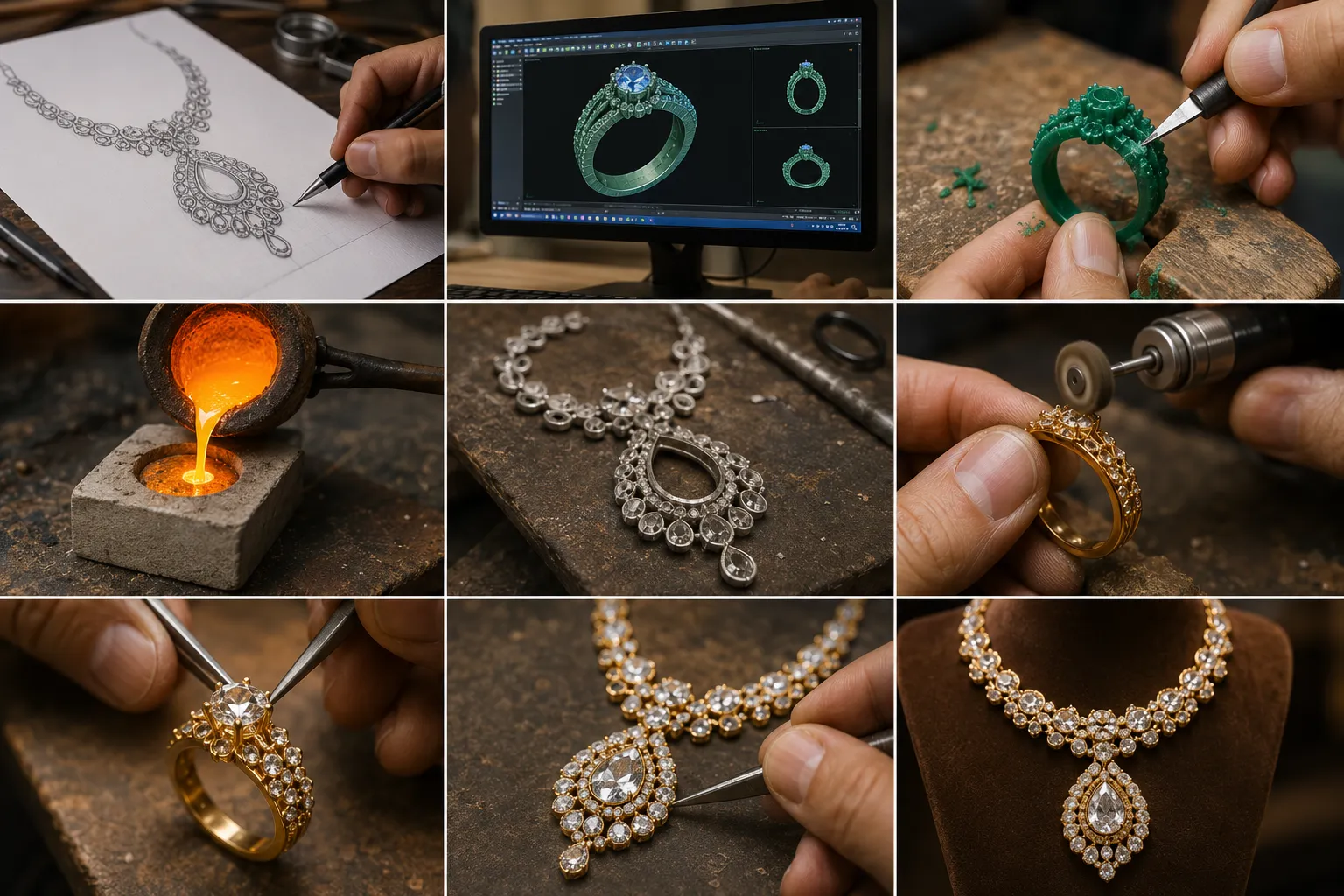
Jewellery is much more than a beautiful accessory it is the result of creativity, precision, craftsmanship, and advanced technology. Every ring, necklace, bracelet, or pair of earrings goes through a detailed manufacturing process before reaching a jewellery showroom. Understanding the behind the scenes of jewellery manufacturing journey helps us appreciate the skill and dedication required to create timeless pieces.
Today, the jewellery industry combines traditional craftsmanship with modern innovations such as Computer-Aided Design (CAD), 3D printing, and advanced gemstone setting techniques. Whether it’s a luxury diamond necklace or a simple gold ring, every jewellery piece tells a story of meticulous planning and expert craftsmanship.
In this blog, we’ll take you behind the scenes of jewellery manufacturing and explore the fascinating steps involved in transforming an idea into a masterpiece.
Step 1: Jewellery Design and Concept Development
Every jewellery piece begins with an idea.
Jewellery designers gather inspiration from nature, architecture, culture, fashion trends, and customer preferences. They sketch multiple concepts before selecting the most suitable design.
At this stage, designers focus on:
- Shape and proportions
- Gemstone placement
- Metal selection
- Wearability
- Customer preferences
A strong design forms the foundation of a successful jewellery piece.
Step 2: CAD (Computer-Aided Design)
Modern jewellery manufacturing relies heavily on CAD (Computer-Aided Design).
Using specialized software, designers convert hand sketches into highly accurate 3D digital models.
CAD offers several advantages:
- Precise measurements
- Easy design modifications
- Realistic visualization
- Reduced manufacturing errors
- Faster production
CAD technology has revolutionized jewellery design by improving both creativity and accuracy.
Step 3: Creating the Wax Model
Once the CAD model is finalized, a wax model is produced using 3D printing or traditional wax carving techniques.
The wax model serves as the prototype of the jewellery piece.
It allows manufacturers to:
- Check design accuracy
- Verify proportions
- Evaluate comfort
- Make final modifications before casting
This stage helps avoid costly mistakes during production.
Step 4: Casting the Jewellery
Casting is one of the most important stages behind the scenes of jewellery manufacturing.
The wax model is placed inside a mould and covered with a special investment material.
During heating:
- The wax melts away.
- Molten precious metal is poured into the mould.
- Gold, silver, platinum, or other alloys take the shape of the original design.
After cooling, the mould is carefully broken to reveal the metal jewellery piece.
Step 5: Cleaning and Finishing
Freshly cast jewellery is rough and requires careful finishing.
Professional craftsmen perform several tasks:
- Removing excess metal
- Filing rough edges
- Sanding surfaces
- Polishing
- Buffing
The objective is to achieve a smooth, elegant finish that enhances the jewellery’s beauty.
Step 6: Gemstone and Diamond Setting
If the design includes gemstones, skilled stone setters carefully secure each stone.
Popular setting styles include:
- Prong Setting
- Bezel Setting
- Channel Setting
- Pavé Setting
- Tension Setting
Stone setting requires exceptional precision because improper placement can affect both appearance and durability.
Step 7: Quality Inspection
Every jewellery piece undergoes rigorous quality control before reaching customers.
Experts inspect:
- Metal purity
- Stone security
- Finish quality
- Symmetry
- Surface defects
- Overall craftsmanship
Quality assurance ensures every product meets industry standards.
Step 8: Hallmarking and Certification
Many jewellery pieces receive hallmarking and certification before being sold.
Certification helps customers verify:
- Gold purity
- Diamond quality
- Gemstone authenticity
- Manufacturing standards
This provides confidence and transparency for buyers.
Modern Technology in Jewellery Manufacturing
The jewellery industry has evolved significantly with technology.
Today’s manufacturers use:
- CAD software
- 3D printing
- Laser engraving
- Laser welding
- Advanced gemstone microscopes
- Precision casting equipment
These innovations improve efficiency while maintaining exceptional craftsmanship.
Skills Required in Jewellery Manufacturing
Successful jewellery manufacturing depends on professionals with diverse skills, including:
- Jewellery Design
- Gemmology
- CAD Designing
- Diamond Grading
- Stone Setting
- Metal Craftsmanship
- Quality Control
Each stage requires specialized knowledge and hands-on experience.
Career Opportunities in Jewellery Manufacturing
The growing gems and jewellery industry offers exciting career opportunities, including:
- Jewellery Designer
- CAD Designer
- Gemologist
- Diamond Grader
- Jewellery Manufacturing Executive
- Quality Control Inspector
- Stone Setter
- Production Supervisor
With global demand for fine jewellery increasing, skilled professionals continue to be highly sought after.
Learn Jewellery Manufacturing at Institute of Gems and Jewellery
If you’re passionate about jewellery and dream of building a successful career in the industry, professional education is the first step.
At Institute of Gems and Jewellery, students receive industry-oriented training that combines creativity with practical skills.
Our courses cover:
- Jewellery Design
- Gemmology
- Diamond Grading
- CAD Jewellery Design
- Gemstone Identification
- Jewellery Manufacturing Techniques
Students gain practical exposure to the complete jewellery manufacturing process, preparing them for rewarding careers in the global gems and jewellery industry.
Whether you aspire to become a jewellery designer, gemologist, CAD designer, or manufacturing professional, our experienced faculty and hands-on training can help you achieve your goals.
Why Understanding Jewellery Manufacturing Matters
Knowing behind the scenes of jewellery manufacturing allows consumers and aspiring professionals to appreciate the artistry behind every jewellery piece.
From the initial sketch to the final polish, each stage reflects creativity, precision, and dedication. Modern technology has enhanced the manufacturing process, but skilled craftsmanship remains at the heart of every beautiful piece of jewellery.
Conclusion
The journey behind the scenes of jewellery manufacturing is a perfect blend of art, science, and innovation. Every piece of jewellery is the result of careful planning, advanced technology, and expert craftsmanship.
If you’re inspired by the world of jewellery and want to turn your passion into a profession, learning from experienced industry experts can open the door to exciting career opportunities. At the Institute of Gems and Jewellery, we are committed to helping students develop the skills and confidence needed to excel in the ever-evolving gems and jewellery industry.
FAQs
1. What is the jewellery manufacturing process?
The jewellery manufacturing process includes designing, CAD modelling, wax model creation, casting, polishing, gemstone setting, quality inspection, and certification.
2. What technology is used in jewellery manufacturing?
Modern jewellery manufacturing uses CAD software, 3D printing, laser engraving, precision casting, and advanced gemstone testing equipment.
3. What skills are needed for jewellery manufacturing?
Key skills include jewellery design, CAD, gemmology, diamond grading, stone setting, metalworking, and quality control.
4. Can I learn jewellery manufacturing professionally?
Yes. The Institute of Gems and Jewellery offers professional courses in Jewellery Design, Gemmology, CAD Jewellery Design, and related disciplines, helping students gain practical industry-ready skills.