
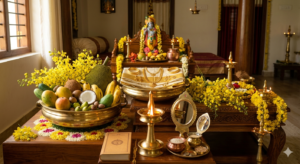
At the Institute of Gems and Jewellery, we study jewellery not just as adornment, but as archive. Every piece holds history, geography, and belief. And few festivals teach us this better than Vishu.
In Kerala, the Malayalam New Year begins not with fireworks, but with Vishukkani , the “first sight” of auspicious things. At the center of that sight, catching the flame of the nilavilakku, is gold. The tradition of gold for Vishu is a living case study in how jewellery becomes ritual, memory, and identity.
1. Vishukkani: Why Gold Is the First Lesson of the Year
The Vishukkani is curated overnight by the matriarch of the house. An uruli is filled with rice, fruits, kani konna flowers, a mirror, a lit lamp, Lord Krishna’s idol, and gold coins or jewellery. At dawn, family members are led to it with eyes closed.
As students of jewellery, this tells us something profound: gold is treated as a symbol before it is an asset. In the kani, gold represents aishwaryam divine prosperity. To see gold for Vishu first thing is to set an intention for abundance, light, and dharma for the year ahead. This is jewellery as visual prayer, a concept we explore deeply in our Heritage Design modules.
2. Color Theory in Tradition: Konnapoo and the Language of Gold
Vishu coincides with the blooming of Cassia fistula, or kani konna. Its cascading yellow flowers are essential to the kani. Their color is not accidental.
In Indian design psychology, yellow and gold signify wealth, auspiciousness, and sattva — positive energy. The konnapoo mirrors the gold beside it, creating a unified visual language. Even the kasavu textile tradition — white with gold borders worn on Vishu follows this code. For jewellery designers, this is a masterclass: gold for Vishu shows how color, botany, textile, and metal work together to communicate “prosperity” without a single word.
3. The Ornaments We Wear: Kasu Mala, Nagapadam, and Living Craft
Vishu is when heirloom jewellery leaves the locker. Women wear kasu mala — necklaces strung with gold coins bearing Lakshmi’s image. Mullamottu mala, palakka mala, and nagapadam pendants also emerge. Men wear simple gold chains or bracelets.
These are not random choices. Each form is a chapter of Kerala’s goldsmithing heritage. The kasu mala traces back to temple jewellery and old Travancore coinage. Nagapadam uses enamel and serpentine motifs linked to fertility and protection. Wearing gold for Vishu is therefore an annual exhibition of craft lineages — techniques like granulation, filigree, and coin embossing passed through acharis. At IGJ, we document these pieces as material culture, not just fashion.
4. Kaineettam: Gold as Intergenerational Transfer
One of Vishu’s most loved customs is kaineettam, where elders gift money to younger members. Traditionally, this was a gold or silver coin, often placed on a betel leaf.
From a socio-cultural lens, kaineettam is India’s oldest financial literacy tool. The coin symbolizes danam and anugraham giving and blessing. It teaches the next generation that wealth is for circulation and safekeeping. This is why gifting gold for Vishu endures: the coin is small, but the message is generational — “May your prosperity grow.”
At IGJ, we believe a jeweller must be a custodian of culture before being a creator. The tradition of gold for Vishu teaches us:
1. Design has meaning: Every motif, from kasu to nagapadam, has a story.
2. Craft has context: Pieces are worn on specific days for specific reasons.
3. Jewellery has duty: It carries blessings, memory, and identity across generations.
Vishu shows us that gold’s value isn’t set by the market alone. It’s set by the moment a child opens their eyes, sees the kani, and understands: “This is who we are.”
This Vishu, look beyond the carats. Look at the craft. At the hands that made the kasu mala. At the grandmother who arranged the kani. At the coin that will be gifted. That is the real education in gold for Vishu and it’s what we’re proud to preserve and teach.