
The Queen Nazli diamond necklace is a remarkable example of how fine jewellery can preserve history, craftsmanship and royal heritage in a single creation. Designed by the renowned French jewellery house Van Cleef & Arpels, the necklace was made in 1939 for Queen Nazli of Egypt and became part of one of the most memorable royal wedding occasions of the 20th century.
With hundreds of diamonds set in platinum and a distinctive Art Deco design, the necklace represents an important period in high jewellery. Its journey from the Egyptian royal court to international auctions and museum exhibition has also made it an interesting case study for anyone interested in diamonds, jewellery valuation and provenance.
Who Was Queen Nazli?
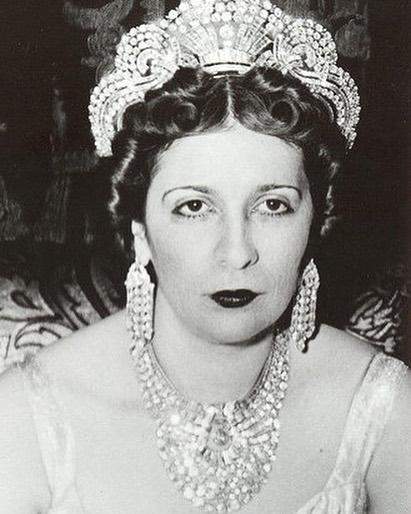
Queen Nazli was the wife of King Fuad I of Egypt and the mother of King Farouk. As a member of Egypt’s royal family, she was closely associated with the country’s royal court during an important period of its modern history.
Jewellery played an important role in royal appearances during this era. Pieces commissioned for members of royal families were often designed not only for their beauty but also to represent status, occasion and cultural significance.
The Queen Nazli diamond necklace is particularly notable because of its connection to a major royal wedding.
The Story Behind the Queen Nazli Diamond Necklace
The necklace was created in 1939 by Van Cleef & Arpels for Queen Nazli. It was commissioned for the wedding of her daughter, Princess Fawzia of Egypt, to Crown Prince Mohammad Reza Pahlavi of Iran.
The wedding brought together two prominent royal families, making it a significant international event. Queen Nazli wore the diamond necklace during the celebrations, giving the piece an important place in royal jewellery history.
The necklace’s association with this event is an example of jewellery provenance the documented history of ownership and use that can add considerable importance to an exceptional jewel.
A 673-Diamond Masterpiece
One of the defining characteristics of the Queen Nazli diamond necklace is its impressive collection of diamonds.
The necklace contains 673 diamonds, with a combined weight of approximately 204 carats. Its design incorporates both round and baguette-cut diamonds within a platinum setting.
The use of different diamond cuts creates contrast between brilliance and geometric structure. Round diamonds are known for their strong light performance, while baguette diamonds contribute clean lines and a more architectural appearance.
This combination is particularly appropriate for an Art Deco jewellery design.
The Art Deco Influence
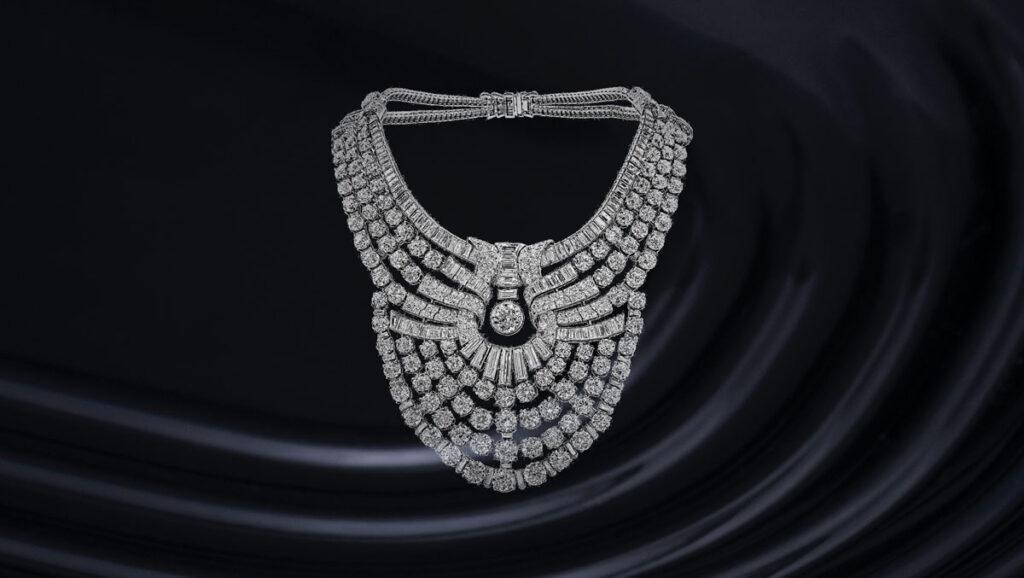
The 1930s were an important period for Art Deco jewellery. Designers increasingly moved towards geometric forms, symmetry and streamlined patterns instead of the elaborate naturalistic motifs associated with some earlier jewellery styles.
The Queen Nazli diamond necklace reflects this design philosophy.
Its arrangement of diamonds creates a structured appearance, while the platinum setting provides a neutral foundation that allows the diamonds to dominate visually.
For jewellery students, this piece demonstrates how design principles can influence the appearance of gemstones. The beauty of a diamond jewel is not determined only by the size or number of stones. Cut, arrangement, proportion, setting and overall design all contribute to the final appearance.
Why Platinum Was Used
Platinum became particularly important in high jewellery during the Art Deco period.
Its strength allows jewellers to create relatively delicate structures while securely holding valuable gemstones. Its naturally white appearance also works well with diamonds because it does not introduce a strong contrasting colour around the stones.
In a piece such as the Queen Nazli diamond necklace, platinum helps create the clean, sophisticated appearance associated with 1930s high jewellery.
The Importance of Diamond Cuts
The necklace is also interesting from a gemological perspective because it uses different diamond shapes.
Round Diamonds
Round diamonds are widely recognised for their ability to return light and create strong sparkle. Their circular outline also provides visual softness within a geometric design.
Baguette Diamonds
Baguette diamonds have a long, rectangular shape. They are generally used to create lines, borders and structured patterns rather than maximum brilliance.
When round and baguette diamonds are combined, the designer can create a balance between sparkle and geometry.
This makes the Queen Nazli piece a useful example of how diamond selection can support a jewellery designer’s artistic intention.
From Royal Jewellery to the Auction Market
The history of the necklace did not end with the Egyptian royal family.
The jewel eventually entered the international auction market. In 1975, it was sold by Sotheby’s in New York for around $140,000.
The necklace returned to the auction market decades later. In 2015, it achieved approximately $4.3 million at Sotheby’s.
The difference between these auction results illustrates how the value of historical jewellery can change dramatically over time.
However, the value of an important jewel cannot be calculated simply by adding the market price of its diamonds. Factors such as provenance, designer, craftsmanship, rarity, condition, historical importance and previous auction records can have a major influence on its value.
Why Provenance Matters in Jewellery
The Queen Nazli diamond necklace is an excellent example of the importance of provenance.
Imagine two necklaces containing diamonds of similar quality and weight. One has an ordinary ownership history, while the other can be traced to a royal collection and a historically significant event.
The second piece may have substantially greater cultural and market importance.
This is why professional jewellery appraisal involves much more than examining gemstones. Experts may need to consider documentation, previous ownership, design characteristics, maker’s marks, condition and historical records.
For aspiring gemologists and jewellery professionals, provenance is therefore an important part of understanding high-value jewellery.
The Necklace Returns to the Spotlight
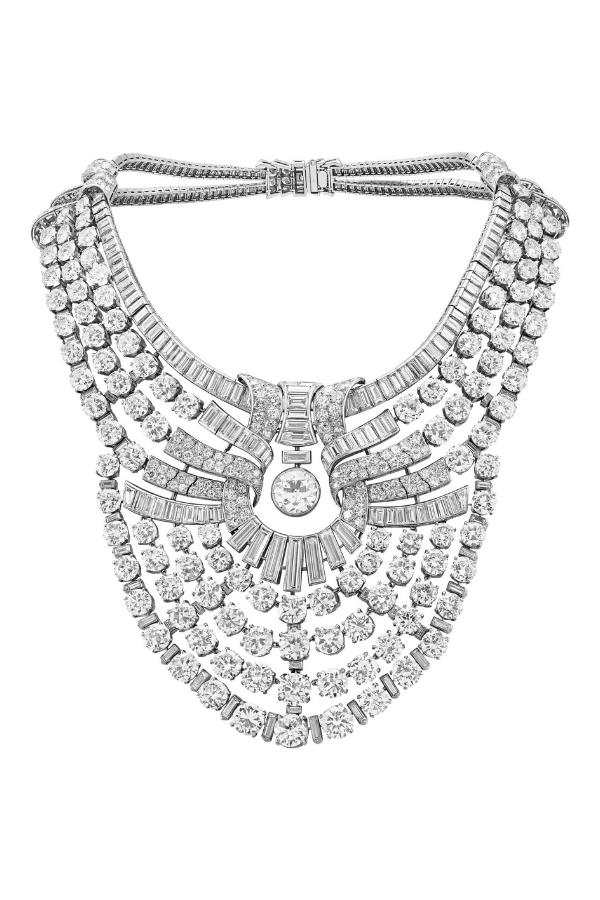
The Queen Nazli diamond necklace attracted renewed international attention in 2026 when it was exhibited in Vienna as part of a Van Cleef & Arpels jewellery exhibition.
The necklace was subsequently reported stolen from the Museum of Applied Arts (MAK) in Vienna on August 27, 2026. Reports stated that the thieves broke the display case and escaped with the historic jewel.
The incident brought attention not only to the necklace itself but also to the challenges involved in protecting high-value jewellery displayed in museums.
For museums, exhibiting jewellery requires a careful balance between public access, educational value and security. Historic jewellery can be irreplaceable because its significance comes from a combination of physical materials and historical provenance.
More Than a Diamond Necklace
It is easy to look at a jewel containing more than 200 carats of diamonds and focus primarily on its monetary value. However, the story of the Queen Nazli diamond necklace demonstrates why important jewellery should also be viewed as historical and artistic material.
The necklace connects several different areas:
- Egyptian royal history
- Iranian royal history
- Art Deco design
- Diamond craftsmanship
- Platinum jewellery
- Van Cleef & Arpels heritage
- Jewellery provenance
- International auctions
- Museum collections
Each of these elements contributes to the identity of the jewel.
What Can Jewellery Students Learn From It?
For students studying gemology and jewellery, the Queen Nazli necklace provides several valuable lessons.
First, gemstone quality and design work together. A large collection of diamonds becomes more visually powerful when the stones are carefully arranged.
Second, jewellery design reflects its period. The geometric structure of the necklace reflects the Art Deco aesthetic of the 1930s.
Third, provenance can influence value. The history of a jewel may be as important as its materials when assessing an exceptional piece.
Finally, craftsmanship creates longevity. A well-designed and expertly constructed jewel can remain significant for generations.
The Legacy of the Queen Nazli Diamond Necklace
The Queen Nazli diamond necklace is more than a historic piece of diamond jewellery. It represents the meeting point of royal history, high jewellery craftsmanship, gemstone design and cultural heritage.
Created in 1939, worn during a significant royal wedding and later appearing at major international auctions and a museum exhibition, the necklace has travelled through a remarkable history.
Its story also demonstrates why diamonds and precious jewellery continue to fascinate people around the world. Their importance can extend beyond beauty and financial value to include art, history, craftsmanship and human stories.
For jewellery professionals and students, the necklace offers a valuable reminder that every exceptional jewel has a story and understanding that story can make the study of jewellery even more meaningful.
Frequently Asked Questions
Who owned the Queen Nazli diamond necklace?
The necklace was created for Queen Nazli of Egypt and was associated with the Egyptian royal family.
Who designed the Queen Nazli diamond necklace?
It was created by the French high-jewellery house Van Cleef & Arpels in 1939.
How many diamonds are in the Queen Nazli necklace?
The necklace contains 673 diamonds, with a combined weight of approximately 204 carats.
What style is the Queen Nazli necklace?
The necklace is an example of Art Deco jewellery, featuring geometric forms and a platinum setting.
Why is the necklace historically important?
Its importance comes from its royal provenance, association with the 1939 wedding of Princess Fawzia of Egypt, its exceptional diamond content, its Art Deco design and its documented auction history.
What happened to the Queen Nazli diamond necklace in 2026?
It was reported stolen from Vienna’s Museum of Applied Arts in August 2026 while being displayed in a Van Cleef & Arpels exhibition.