
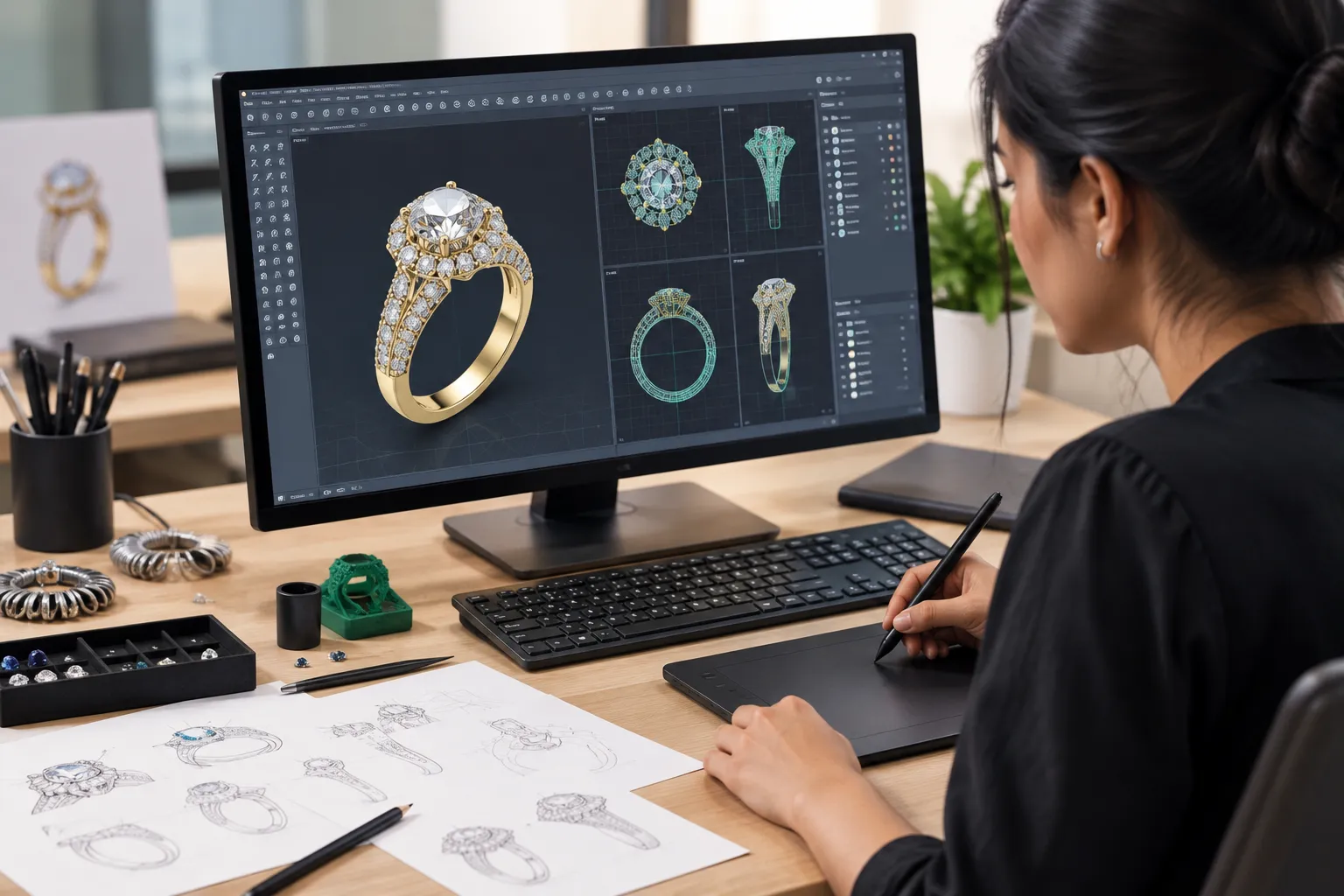
The jewellery industry is evolving with technology, and Jewellery CAD Designers are playing an increasingly important role in modern jewellery design and production. Computer-Aided Design (CAD) allows designers to transform creative ideas into accurate 3D jewellery models before they are manufactured.
From rings and earrings to necklaces, bracelets, and intricate gemstone jewellery, CAD technology helps designers visualise, modify, and prepare jewellery designs for production. It combines creativity, technical knowledge, and an understanding of jewellery manufacturing.
For students and aspiring jewellery professionals, becoming a Jewellery CAD Designer can open up exciting career opportunities in jewellery manufacturing, design studios, retail brands, product development, and freelance design.
What Is a Jewellery CAD Designer?
A Jewellery CAD Designer creates digital 2D and 3D models of jewellery using specialised CAD software. These digital models can be used for design presentations, realistic rendering, prototyping, 3D printing, and manufacturing.
Unlike traditional hand-drawn jewellery design, CAD allows designers to view a piece from different angles and make precise changes before production begins. This makes the design process more flexible and helps connect creative concepts with practical manufacturing requirements.
What Does a Jewellery CAD Designer Do?
The role involves much more than simply creating attractive 3D models. A professional Jewellery CAD Designer must understand how a digital design will eventually become a physical jewellery piece.
Common responsibilities include:
- Creating 3D jewellery models
- Converting sketches and concepts into digital designs
- Designing rings, earrings, pendants, necklaces, and bracelets
- Creating gemstone settings and stone seats
- Maintaining accurate dimensions and proportions
- Preparing designs for manufacturing
- Creating realistic jewellery renders
- Making revisions based on client or production requirements
- Working with designers, manufacturers, setters, and product-development teams
- Preparing files for 3D printing or other manufacturing processes
Industry occupational standards for jewellery CAD also emphasise dimensions, stone placement, material information, manufacturing specifications, and practical production requirements.
Why Is CAD Important in Jewellery Design?
CAD has changed the way many jewellery businesses develop and manufacture products. Designers can create, modify, and present designs digitally before committing to physical production.
A CAD model can also support prototyping and manufacturing workflows, including 3D printing and other computer-aided manufacturing processes. Professional jewellery CAD programmes therefore combine design skills with manufacturing knowledge.
Key advantages of CAD jewellery design include:
Precision: Designers can work with accurate dimensions and proportions.
Faster modifications: Design changes can be made without recreating an entire physical model.
Better visualisation: 3D models allow clients and teams to view a design from multiple angles.
Easy prototyping: Digital files can be used in 3D printing workflows.
Production planning: Designers can consider stone settings, materials, dimensions, and manufacturing requirements before production.
Essential Skills for a Jewellery CAD Designer
A successful Jewellery CAD Designer needs a combination of creative and technical skills.
1. CAD Software Skills
Software proficiency is one of the most important requirements. Jewellery professionals may work with tools such as Rhino 3D, MatrixGold, ZBrush, JewelCAD, and rendering software, depending on the company and type of work.
2. Jewellery Design Knowledge
Understanding jewellery construction is essential. Designers should know about different types of settings, jewellery components, proportions, stone placement, and design styles.
3. Manufacturing Knowledge
A beautiful digital model is not enough if it cannot be manufactured. CAD designers need to understand practical considerations such as wall thickness, stone settings, tolerances, metal usage, and production methods.
4. Understanding of Gemstones
Knowledge of gemstone shapes, sizes, proportions, and setting requirements helps designers create more practical and visually balanced jewellery.
5. Creativity
CAD is a technical process, but creativity remains at the heart of jewellery design. Designers need to develop original concepts and translate visual ideas into attractive jewellery.
6. Attention to Detail
Small errors in dimensions, stone placement, or proportions can affect the final product. Accuracy and attention to detail are therefore essential.
7. Communication Skills
A CAD designer may work with clients, jewellery designers, production teams, manufacturers, merchandisers, and craftsmen. The ability to understand briefs and communicate design information is an important professional skill.
Popular CAD Software for Jewellery Design
Different companies use different software depending on their design and production requirements.
Rhino 3D
Rhino is a widely used 3D modelling platform that can be used for detailed jewellery modelling and complex forms.
MatrixGold
MatrixGold provides jewellery-specific tools and workflows for creating rings, settings, patterns, and other jewellery designs.
ZBrush
ZBrush is particularly useful for digital sculpting and creating highly detailed or organic forms.
JewelCAD
JewelCAD is another software platform used for jewellery design and 3D modelling.
The right software depends on the designer’s goals, employer requirements, and the type of jewellery being created.
Jewellery CAD Design Process
A typical CAD jewellery workflow can involve several stages.
Step 1: Understand the Design Brief
The process begins with a concept, sketch, reference image, or client requirement.
Step 2: Develop the Digital Model
The designer creates the basic structure and proportions of the jewellery piece using CAD software.
Step 3: Add Details
Stone settings, patterns, textures, curves, engravings, and other design elements are developed.
Step 4: Check Manufacturing Requirements
The design is reviewed for dimensions, proportions, stone placement, material usage, and production feasibility.
Step 5: Create a Render
A realistic render can help clients and teams visualise the finished jewellery before manufacturing.
Step 6: Prepare for Production
Once approved, the CAD file can move into the appropriate prototyping or manufacturing workflow, such as 3D printing and casting.
How to Become a Jewellery CAD Designer
If you are interested in this career, a structured learning path can help.
1. Learn Jewellery Design Basics
Start by understanding jewellery components, gemstones, metals, settings, proportions, and basic manufacturing concepts.
2. Develop Drawing Skills
Sketching remains useful because it helps designers develop and communicate concepts before moving into 3D modelling.
3. Learn Professional CAD Software
Choose a suitable jewellery CAD programme and practise regularly. Focus on understanding the tools rather than simply following tutorials.
4. Practise Different Jewellery Categories
Build experience by creating different products such as:
- Rings
- Earrings
- Pendants
- Bracelets
- Bangles
- Necklaces
- Bridal jewellery
- Gemstone jewellery
5. Understand Manufacturing
Learn how your digital models are converted into physical jewellery. Knowledge of production can help you create more practical and manufacturable designs.
6. Build a Strong Portfolio
A portfolio is one of the best ways to demonstrate your skills. Include different designs, renders, technical details, and examples that show your versatility.
Jewellery CAD Designer Career Opportunities
A Jewellery CAD Designer can explore different roles within the jewellery industry.
Potential career paths include:
- Junior CAD Designer
- Jewellery CAD Designer
- Senior CAD Designer
- CAD Technician
- Jewellery Designer
- Product Developer
- 3D Jewellery Designer
- CAD/CAM Professional
- Freelance Jewellery CAD Designer
The Gem & Jewellery Skill Council of India identifies employment opportunities such as junior/executive CAD designer, CAD intern, CAD operator, and freelance CAD designer.
With experience, designers can also move towards senior design, product development, team leadership, or independent freelance work.
Jewellery CAD Designer as a Freelance Career
CAD skills can also create opportunities outside traditional full-time employment.
Freelance designers can work with jewellery brands, manufacturers, designers, exporters, and individual clients. Depending on their skills, they may provide services such as:
- 3D jewellery modelling
- CAD modifications
- Rendering
- Product development
- Custom jewellery design
- Manufacturing-ready CAD files
Building a strong portfolio and understanding production requirements can help freelancers attract professional clients.
Why Learn Jewellery CAD Design?
Learning jewellery CAD design can be beneficial for people who enjoy both creativity and technology.
It allows designers to:
- Turn ideas into 3D jewellery
- Experiment with different designs
- Make accurate modifications
- Create realistic visual presentations
- Work with modern manufacturing technologies
- Explore employment and freelance opportunities
Modern jewellery CAD education increasingly combines modelling with manufacturing knowledge, rendering, and CAM processes.
Future of Jewellery CAD Design
The future of jewellery design is likely to become increasingly digital. CAD, rendering, 3D printing, and computer-aided manufacturing are already influencing how jewellery is designed and developed.
However, technology does not replace creative thinking. The strongest designers combine design creativity, CAD expertise, jewellery knowledge, and manufacturing awareness.
As jewellery businesses continue adopting digital workflows, professionals who can create attractive and production-ready designs can play an important role in the industry’s future.
Conclusion
A career as a Jewellery CAD Designer offers an exciting combination of creativity, technology, and jewellery craftsmanship. From developing an initial concept to creating a production-ready 3D model, CAD designers contribute to several stages of modern jewellery development.
For aspiring jewellery professionals, learning CAD software alongside jewellery design, gemstone knowledge, and manufacturing principles can provide a strong foundation for career growth. With continuous practice and a professional portfolio, jewellery CAD design can lead to opportunities in design studios, jewellery brands, manufacturing companies, product development, and freelance work.
FAQ
What is a Jewellery CAD Designer?
A Jewellery CAD Designer creates digital 2D and 3D models of jewellery using computer-aided design software for visualisation, prototyping, and manufacturing.
What software is used for jewellery CAD design?
Commonly used tools include Rhino 3D, MatrixGold, ZBrush, JewelCAD, and various rendering platforms. The software used depends on the designer and workplace.
Is CAD design a good career in the jewellery industry?
Yes. CAD design offers career opportunities in jewellery manufacturing, design studios, product development, jewellery brands, and freelance work.
Do Jewellery CAD Designers need jewellery knowledge?
Yes. Understanding jewellery construction, gemstones, settings, materials, and manufacturing helps designers create practical and production-ready models.
Can I become a Jewellery CAD Designer without a design degree?
A formal design degree is not necessarily the only route. Practical CAD skills, jewellery knowledge, and a strong portfolio are important for demonstrating your ability to employers and clients.
What should I include in a Jewellery CAD portfolio?
Include a variety of jewellery designs such as rings, earrings, pendants, bracelets, and gemstone pieces. Add high-quality renders and examples that demonstrate your modelling accuracy and understanding of production.