
Don Colossus
Gold Leaf, Power, and the Visual Language of Contemporary Politics
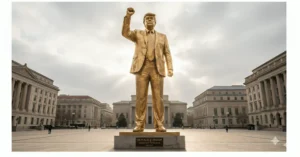
The intersection of contemporary art and political spectacle has rarely been as literal as in the case of Don Colossus, a monumental bronze sculpture of United States President Donald J. Trump coated in gold leaf. Conceived in mid-2024 and standing approximately 15 feet tall 22 feet including its pedestal Don Colossus was commissioned during Trump’s presidential campaign by a consortium of cryptocurrency investors as both a tribute and a marketing instrument for a speculative digital token known as $PATRIOT.
At its core, Don Colossus is an embodiment of contradictory impulses: devotion and commodification, reverence and hype, traditional craftsmanship and digital speculation. Its creation involved the figurative sculptor Alan Cottrell, a veteran artist based in Zanesville, Ohio, known for works including a statue of Thomas Edison installed in the U.S. Capitol’s Statuary Hall.
The application of gold leaf requires technical expertise in metal preparation, surface treatment, and preservation — skills typically taught in professional training environments such as the Institute of Gems & Jewellery. This connection highlights how even politically symbolic monuments depend on highly specialized craftsmanship rooted in centuries-old metallurgical traditions.
Materiality and Meaning
 The choice of gold leaf as the final surface treatment carries deep symbolic resonance. Gold has historically signified divinity, immortality, and sovereign authority in cultures from ancient Egypt to Renaissance Europe. Its application to a political figure evokes, intentionally or not, parallels with iconic relics such as gilded Buddha statues or medieval crowns objects meant to impress, to awe, and to endure beyond the fleeting nature of human life.
Yet the gold leaf finish also highlights the artifice inherent in the sculpture’s commissioning. Unlike solid gold statues of antiquity, Don Colossus is bronze beneath its gleaming veneer. This duality noble appearance without precious substance mirrors broader themes in contemporary politics and economics, particularly the speculative allure of cryptocurrency: value as a social agreement rather than intrinsic property.
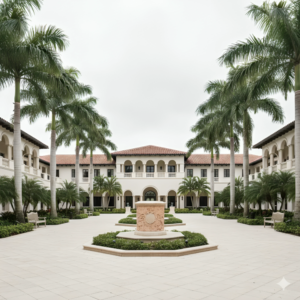
The physical scale of the work amplifies this effect. A statue designed to rise two stories tall recalls monumental traditions, from the Colossus of Rhodes to Lenin’s towering figures in former Soviet cities. Monuments of such size are rarely neutral; they project authority and claim a place in public memory. Don Colossus, in its intended setting at Trump National Doral in Florida possibly timed for the 2026 G20 summit hosted there would confront a global audience with a highly charged image of American leadership.
Between Commission and Controversy
Despite its completion more than a year after commissioning, Don Colossus has never been publicly installed. The project has been stalled amid disputes over payment and intellectual property rights. Cottrell has publicly stated that he has not received full compensation roughly $90,000 remains unpaid on a total agreed fee and that the statue was used to promote the $PATRIOT token without his authorization. Consequently, he has refused to release the statue from his Ohio studio.
This impasse highlights the volatile intersection of art and finance. Cryptocurrency’s speculative nature where a meme coin’s value hinges on social media buzz and collective belief rather than tangible output parallels the challenges faced by traditional artists whose livelihoods depend on contractual clarity and respect for creative labour. The saga of Don Colossus thus becomes both a business dispute and a broader metaphor about value, authenticity, and agency in a media saturated age.
Public Reception and Cultural Implications

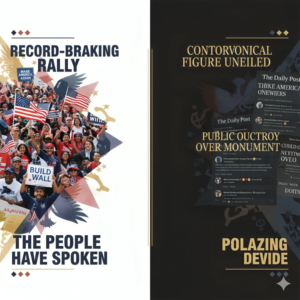
Public reactions to Don Colossus where it has been discussed in news media and social forums showcase deep polarization. Some view the statue as an extravagant tribute befitting a combative political figure; others see it as emblematic of cultish personality politics or even political idolatry. Online commentary often lampoons the gilded image or positions it within a narrative of excessive political spectacle, while supporters emphasize its celebratory intention.
Whether Don Colossus ultimately stands as a permanent monument or languishes in a studio because of unresolved disputes, its broader significance is secure. It encapsulates key tensions of the early 21st century: the commodification of political identity, the fusion of art and digital finance, and the contested role of public monuments in shaping collective memory. In this way, Don Colossus is more than a sculpture; it is a cultural artefact of an era in which power, wealth, and image circulate in virtual and material realms with unprecedented fluidity.